
If you are looking for a direct answer, a standard 25kg bag of Alpha fish feed in Nigeria currently sells between ₦29,250 and ₦31,050, depending on your location, the specific pellet size, and whether you are buying retail or wholesale. This price positions Alpha as a highly competitive, mid-tier, high-performance option for aquaculture businesses looking to balance excellent feed conversion ratios with the harsh economic realities of modern farming.
But as any experienced farmer will tell you, the price tag on a single bag is only a tiny fraction of the story. In fish farming, feed consistently accounts for 60% to 70% of your total operational costs. If you do not understand how to budget your feed cycles, calculate your feed conversion ratios, or navigate the wild price fluctuations in the open market, even the best feed brand won’t save your farm from losing money.
Let’s dive deep into what shapes the pricing of Alpha fish feed, how it compares to other options on the market, and how you can manage your feeding regimen to keep your aquaculture business profitable this year.
What Actually Determines the Cost of a Bag?
When you walk into an agro-allied store in Ibadan, Enugu, or Kaduna and notice that feed prices have jumped by a few hundred Naira over the weekend, it is easy to blame the retailer. But here’s the thing: commercial fish feed production is a complex game of nutritional engineering and macroeconomics. Alpha feed is a high-performance floating formula, which means its production process is closely tied to both local commodity prices and global supply chains.
The single biggest cost driver inside that 25kg bag is protein. To get catfish or tilapia to grow from tiny fingerlings to table-size giants within four to five months, the feed must contain high-quality crude protein, usually between 36% and 42%. The traditional golden standard for this is fishmeal, alongside secondary protein sources like soybean meal. Because Nigeria still relies heavily on imported fishmeal and key vitamin premixes, any shifts in the foreign exchange market ripple directly into the warehouse door price.
Beyond the ingredients, there is the manufacturing technology itself. Floating pellets are made using an extrusion process where the mixed ingredients are cooked under intense pressure and heat, then forced through a die to puff up and capture air pockets. This requires massive amounts of energy. With the current cost of industrial diesel and electricity tariffs in Nigeria, local mills face incredibly high overhead costs just to keep the extruders running. When you pay for Alpha feed, you aren’t just buying ground-up corn and soy; you are paying for the energy it took to make that pellet float stably in your pond for hours without dissolving.
Pricing Across Different Pellet Sizes
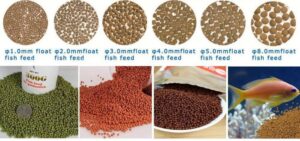
One mistake novice farmers make is assuming that a bag of feed is just a bag of feed. In reality, pellet size plays a significant role in pricing. Smaller pellet sizes—such as 2mm and 3mm—often command a premium on a per-kilogram basis compared to larger grow-out sizes like 6mm or 9mm.
The reason for this lies in the manufacturing efficiency. Extruding millions of tiny 2mm pellets takes more time, tighter calibration, and higher precision than pumping out large chunkier pellets. Furthermore, younger fish require a significantly higher concentration of crude protein and digestible fats to build their immune systems and kickstart their growth trajectory.
To give you a clear picture of what to expect when planning your procurement, here is a breakdown of the typical market prices for Alpha fish feed across various sizes in the major commercial hubs.
| Pellet Size | Recommended Growth Stage | Average Price per 25kg Bag |
| 2mm | Post-Juvenile / Early Grow-out | ₦30,500 – ₦31,050 |
| 3mm | Juvenile / Mid-stage | ₦29,800 – ₦30,300 |
| 4mm | Transition / Advanced Grow-out | ₦29,250 – ₦29,700 |
| 6mm | Table Size Development | ₦29,250 – ₦29,500 |
| 9mm | Heavy Grow-out / Broodstock | ₦29,250 – ₦29,500 |
The catch is that these prices are highly sensitive to geographic location. If you are buying your feed in Lagos, Ogun, or Oyo state—near the major industrial milling corridors—you will likely get prices on the lower end of the spectrum. However, if your farm is located in the South-South delta region or further north in Kano, you must factor in an additional ₦500 to ₦1,500 per bag to cover interstate haulage and regional distributor margins.
Why Alpha Stands Out in the Market
With so many brands competing for space in your feed store, why are so many commercial farmers turning to Alpha? To understand this, we have to look at the three-tier structure of the Nigerian aquaculture market: premium imported options, standard local commercial brands, and artisanal self-formulated “local pellet” feeds.
Premium imported brands like Coppens are undeniably excellent, but they are priced beyond the reach of many mid-scale commercial projects. On the other end of the scale, setting up your own local pelletizer to mix maize, groundnut cake (GNC), and blood meal can save you money upfront, but local sinking pellets often dissolve too quickly. This fouls the water, stresses the fish, and leads to poor Feed Conversion Ratios (FCR).
Alpha effectively occupies the high-utility sweet spot. It provides the water stability and floating duration of an international premium feed while keeping its pricing aligned with local production economics. The pellets are designed to stay afloat long enough for your fish to aggressively consume them, minimizing the waste that settles at the bottom of the pond to rot into toxic ammonia. When your fish convert more of what they eat into clean muscle mass, your cycle shortens, and your profit margins expand.
How to Calculate Your Total Feeding Budget
Before you buy a single fingerling or stock a single pond, you need to do the math. Running out of money for feed mid-way through a production cycle is the absolute quickest way to crash a fish farming business. Stunted fish that are starved for two weeks because the farmer is waiting for cash flow will never convert feed efficiently once you resume feeding. They simply burn the nutrients trying to recover instead of growing.
To build a bulletproof budget, you need to think in terms of the Feed Conversion Ratio (FCR). In plain English, FCR tells you how many kilograms of feed it takes to produce one kilogram of fish meat. For a well-managed concrete or tarpaulin pond using high-quality floating feed like Alpha, a realistic target FCR is 1.2 to 1.5. This means that to harvest 1,000kg (one metric ton) of fish, you will need to feed them roughly 1,200kg to 1,500kg of high-quality pellets over the course of the cycle.
To help you skip the manual spreadsheets and visualize your true operational expenses, use the interactive calculator below. You can adjust your stocking target, expected harvest weight, and local feed costs to instantly see how many bags of Alpha feed you will need and what your baseline investment will look like.
The Hidden Costs Most Farmers Ignore
So what actually matters when evaluating the real cost of your feed? It is rarely just the sticker price at the shop counter. Many farmers lose significant chunks of their profit margin to variables they never recorded in their logbooks.
First up is transportation and handling logistics. If you are buying ten bags of feed at a time, taking a commercial tricycle (Keke) or local taxi back to your farm eats into your margins by adding an implicit cost of several hundred Naira to each bag. For medium to large-scale setups, it almost always makes more sense to collaborate with neighboring farmers to purchase directly from main distributors by the pallet or truckload. This unlocks wholesale discounts and drastically drops your per-bag shipping cost.
The second culprit is poor storage management.
Fish feed is rich in lipids and proteins, making it a prime target for rodents, weevils, and moisture.
If you stack your Alpha feed bags directly against a concrete wall or flat on a damp floor, the bottom bags will absorb moisture, sweat, and develop toxic molds. Feeding moldy pellets to your fish will cause severe liver damage, stall their growth, or trigger sudden mass mortalities. Always stack your bags on elevated wooden pallets in a well-ventilated room, and keep a strict rodent control system in place.
Practical Strategies to Cut Down Feed Costs Without Dropping Quality
When margins get tight due to broader inflationary pressures, the worst thing you can do is abruptly switch to low-grade, cheap feeds that lack proper formulation. Your fish will stop growing uniformly, cannibalism will skyrocket among your catfish, and you will end up spending more money over a longer production cycle. Instead, use these strategic operational tweaks to optimize every single grain of feed you drop into the water.
Master the Art of Phase Feeding
Do not feed your fish high-protein starter feeds longer than necessary. Once your fish hit the post-juvenile stage and can comfortably swallow a 4mm pellet, transition them off the more expensive 2mm or 3mm options. Each step up in pellet size represents a drop in price per bag, allowing you to steadily taper down your feeding costs as the biomass of your pond scales up.
Monitor Your Water Quality Rigorously
Fish are cold-blooded creatures; their metabolic rate and ability to digest food are entirely dependent on their environment. If your pond’s dissolved oxygen levels are low, or if the pH is off-kilton, the fish lose their appetite. If you dump feed into an unoptimized pond, they won’t eat it efficiently.
By performing regular water changes and ensuring high dissolved oxygen levels, you optimize the digestive health of your stock, squeezing the maximum possible growth out of every bag of Alpha feed.
High Water Quality -> Optimal Digestion -> Lower FCR -> More Profit
Feed by Weight, Not by Guesswork
Stop using random paint buckets to scoop feed into your ponds without checking the numbers. Calculate the total biomass of your pond every two weeks by sampling a few fish, weighing them, and using a standardized feeding chart (typically feeding at 3% to 5% of their total body weight daily).
Furthermore, always pay close attention to response feeding. If a sudden rainstorm drops the water temperature, your fish will naturally slow down their feeding activity. Throwing feed into a pond during a heavy downpour is essentially throwing money down the drain.
Summary and Next Steps
Succeeding in the competitive landscape of Nigerian aquaculture requires a sharp shift from looking at farming as a hobby to executing it as a data-driven business. While the price of Alpha fish feed will inevitably shift in lockstep with the broader macroeconomic trends and raw material availability in Nigeria, your ultimate defense against rising input costs is operational efficiency. By selecting a stable, high-utility brand like Alpha, managing your storage defensively, and tracking your Feed Conversion Ratio with absolute precision, you can comfortably protect your margins and scale a profitable harvest cycle after cycle.


